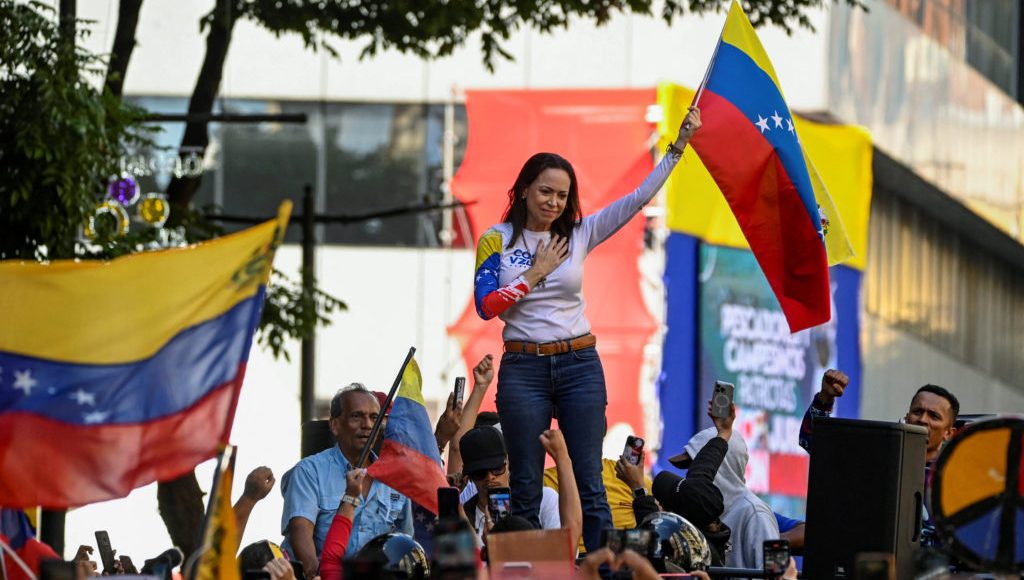

For Americans who believed the 2020 presidential election was stolen, here’s what a real stolen election looks like in Venezuela’s July 2024 election. The vast difference between these two elections shows the profound difference between claims disputed through democratic media and what real authoritarian election manipulation can do.
When I heard about Maria Corina Machado winning the Nobel Peace Prize for her democracy defense in Venezuela, I had never heard of her and didn’t really know what she won the Nobel Peace Prize for. And when I later read about her dedicating her prize to President Trump, I became really interested in learning who she is and what is she thanking Trump for.
Come to find out, Machado has something in common with Trump.
When Nicolás Maduro claimed victory in Venezuela’s 2024 presidential election, the fraud was not subtle. The opposition, led by María Corina Machado and her endorsed candidate Edmundo González Urrutia, had collected photographic evidence from over 80% of polling stations showing González winning by a landslide—67% to Maduro’s 30%. These weren’t allegations or theories; they were documented, verifiable tallies that anyone could examine online.
Yet Maduro’s electoral council declared him the winner with 51.2% of the vote. The regime’s approach was brazen: block opposition witnesses from vote counts, refuse to print legally required paper tallies, and announce partial results hours late while claiming an “irreversible trend.” This wasn’t a dispute over mail-in ballots or signature matching—it was wholesale fabrication of results in defiance of documented evidence.
Perhaps most telling is what happened after Venezuela’s election. While America’s 2020 election disputes played out in over 60 court cases (with judges appointed by both parties examining evidence), Venezuela’s regime simply issued arrest warrants for the opposition leaders. Security forces killed at least six protesters, arrested over 2,000 people, and tortured dissidents. The regime barred Machado from even running, despite her winning opposition primaries with 92% support.
The international response tells the story. The United States, European Union, and most Latin American democracies declared the election fraudulent based on overwhelming evidence. The European Parliament awarded Machado and González the Sakharov Prize for Freedom of Thought, explicitly condemning the “electoral fraud.” Even the typically cautious Carter Center, which has observed elections worldwide for decades, declared Venezuela’s election neither free nor fair.
Only Russia, China, Cuba, and a handful of other authoritarian states recognized Maduro’s victory—not because they believed it legitimate, but because it served their geopolitical interests.
The American electoral system, by contrast, demonstrated its resilience in 2020. Every claim of irregularity was examined through proper channels. Republican-appointed judges, Democratic-appointed judges, and Trump-appointed Supreme Court justices all reviewed cases. State election officials from both parties—including Georgia’s Republican Secretary of State Brad Raffensperger and Arizona’s Republican Governor Doug Ducey—certified results despite enormous political pressure.
Multiple recounts, including a hand recount of all 5 million ballots in Georgia, confirmed the results. The Cybersecurity and Infrastructure Security Agency, led by a Trump appointee, declared it “the most secure election in American history.” When concerns arose, they were investigated thoroughly—not suppressed with violence.
Most importantly, the peaceful transfer of power ultimately occurred. No opposition leaders fled into exile. No protesters were tortured. The courts remained independent, the press remained free, and democracy, though tested, endured.
Venezuela’s stolen election has real consequences. By May 2025, regional elections saw turnout as low as 13% in some areas due to opposition boycotts. Citizens have lost faith in the electoral system entirely. González remains in exile, touring allied nations seeking support, while Machado operates from hiding under constant death threats. Her 2025 Nobel Peace Prize citation specifically honors her “struggle for a peaceful transition from dictatorship to democracy”—a struggle that continues with no end in sight.
This is what stolen elections look like: documented evidence ignored, opposition leaders imprisoned or exiled, protesters killed, international condemnation, and the complete breakdown of democratic participation. It’s not about competing narratives or disputed interpretations—it’s about real power crushing documented truth.
For all Americans, Venezuela offers a crucial reminder: the ability to dispute election results through courts, to demand recounts, to protest peacefully, and to have those concerns addressed through legal channels is not a sign of a broken democracy—it’s proof of a functioning one.
When we see opposition leaders like Machado risking their lives simply to document vote tallies, when we see citizens beaten for demanding their votes be counted, when we see the international community unite in condemning obvious fraud, we understand what real electoral theft looks like. It bears no resemblance to the legal disputes, court hearings, and peaceful protests that characterized America’s 2020 election aftermath.
Our democracy is imperfect and requires constant vigilance to protect and improve. But Venezuela reminds us that in truly stolen elections, there are no court challenges because courts aren’t independent. There are no recounts because authorities won’t allow them. There are rioters because rioters will be shot, not pardoned.
The difference between Venezuela 2024 and America 2020 isn’t just one of degree—it’s the difference between a democracy under stress and a dictatorship dropping its mask. Understanding this distinction isn’t about minimizing concerns over election integrity; it’s about recognizing and protecting the democratic institutions that allow us to address those concerns peacefully and lawfully.
When elections are actually stolen, the world knows it. Venezuela proves that truth.
 ArmstrongTimes
0 comments on “When Elections Are Actually Stolen.”