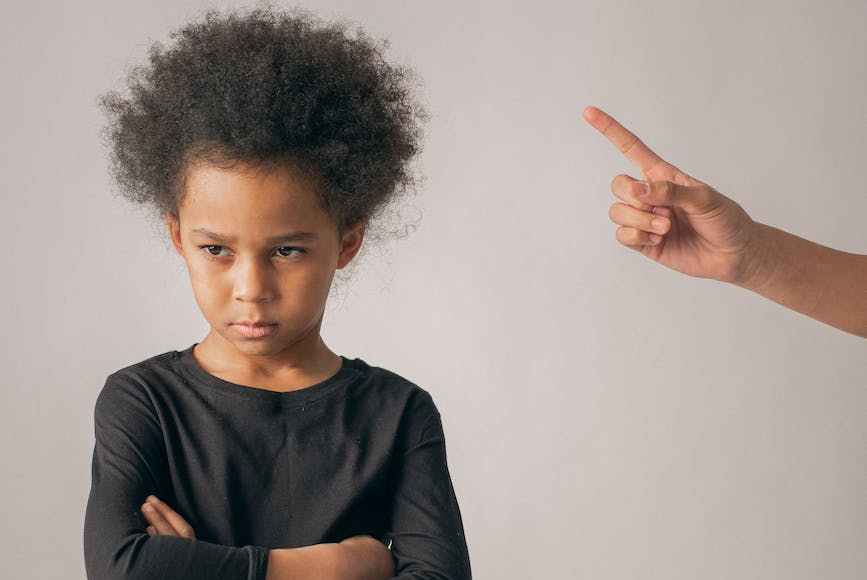

Black people make fun of white parents for not spanking their children but now that I’m a parent, I see the joke is on us.
Growing up my mom made me feel like I couldn’t make a mistake because she punished me for every wrongdoing. I don’t know how old I was but I remember the time I got mad at my mom and said, “You expect us (me and my sister) to be perfect. We can’t do anything wrong, we can’t make a mistake. You got to punish everything you don’t like.”
The pressure to not make a mistake is incredibly strong in Black households. This pressure stems from the fear of appearing imperfect, combined with the consequential punishments that awaits. We grow up being trained to be perfect in a society that is far from it, and no matter how much we reach for perfectionism and “Black Excellence,” we will always fall short just for being Black. Because our Blackness alone is a threat to the white previllage that white people have hated, raped, and murdered so much of us to attain.
In public spaces, Black parents would warn their children not to embarrass them. The irony, however, lies in the fact that disciplining a child in public could be perceived as an embarrassment itself. In marriage, we tell our spouses to defend us publically and correct us privately. Yet, we somehow fall short of applying the same principle when raising our children.
Contrastingly, White parents seldom resort to public spanking. Instead of viewing their children’s public misbehavior as a reflection of bad parenting, they consider it as part of being a child. As a Black community, we’ve been conditioned to be overly concerned with the White gaze. This concern is rooted in very real fears: fears of disproportionate reactions, assumptions about our family structures, or a child’s future being unfairly judged based on their youthful antics.
Though it’s important to remember that not all of this pressure to discipline is racially motivated. Every parent strives to ensure their child behaves appropriately, regardless of the company present. But there is an undeniably different feeling when your child acts out in a predominantly White environment.
As a Black parent today, I’ve noticed how my upbringing has influenced my parenting. I am not suggesting that physical force should never be used. However, it should only be a last resort for serious situations. Our parents’ generation would often resort to spanking for every misstep, neglecting the times when words and explanations would suffice.
Its problematic for Black parents to say they don’t have to explain themselves to their children. Black parents don’t feel like they have to apologize when they are wrong. This causes Black people to grow up taking whatever cards life throws at them. Not questioning those in authority to them. Some Black people will accept a speeding ticket as what they deserve for going over the limit while white people will argue a cop down for interrupting their route. Although, the fear of losing our lives play a huge part in our willingness to accept a punishment. Just as we feared getting spanked.
A common trope that is often propagated within Black families is: “You do what I say because I said so. If you ask questions then you’re talking back.” Although my child is still young, I firmly believe that the essence of my words can be understood, whether I’m praising or correcting.
The concept of spanking as a form of love in Black households is another area that requires introspection. As much as parents may mean well, the association between love and physical punishment can leave a lasting psychological imprint. The impact of this perception is felt far beyond childhood, affecting how we perceive justice, discipline, and punishment in our adult lives.
In society, it’s a bitter fact that Black people often receive harsher punishments than White people for the same crimes. This discrepancy can be internalized as a belief that we deserve our punishments, stemming from the lessons we learned as children. However, it’s time we question this narrative and fight for fair treatment and justice.
Reflecting on our childhood, it becomes clear that the ingrained message of perfection has long-lasting effects. It becomes challenging to separate mistakes from our identity, leading to an internalization of stereotypes about laziness and incompetence.
I do understand why our parents disciplined us the way they did – they were simply doing what they knew, influenced heavily by the societal context in which they were raised. They wanted to protect us from the harsh realities of our society, where misbehavior could lead to drastic consequences. But as we strive to change this narrative for the next generation, it’s crucial we allow room for growth and make space for mistakes, because no one, least of all our children, should be expected to be perfect.
 ArmstrongTimes
0 comments on “We Won’t Spank Our Child.”